Clearing a column: offsetting a cable tray run
When a column, a beam or someone else's pipe is in the way, the run is stepped aside with two turns facing each other and then carries on parallel to the original line. What matters here is not the cut itself but the distance between the notches.
Where it usually goes wrong
It seems logical to measure centre to centre along the length of the diagonal. But each notch takes metal out, and as it folds the bend line draws inward. Miss that allowance and the second turn lands closer than it should, so the run never comes back to the line you planned — it ends up several centimetres off to one side.
How to measure it on site
The easiest way is one pass of the tape: from the edge of the first notch to the centre of the second. That length equals the diagonal, and the allowance takes care of itself. If centre to centre suits you better, the calculator gives that figure too — it is longer by the size of one cut.
Protecting the cut edge
A cut leaves a sharp edge, and the galvanising is broken where the saw went through. Those edges get a ready-made protective trim — a rubber edging for cable containment with reinforcement inside. It covers the edge along its whole length so cable will not catch the metal when it is pulled in. Splice plates can be added on the inside corners as well; they stiffen the joint itself.
Notches on opposite sides
The first turn takes the run sideways, the second brings it back to the original direction. They fold opposite ways, so the notches go on different sides: one side is cut at the first, the other at the second. Put both on the same side and the run curves away instead of straightening out.
What it looks like on site
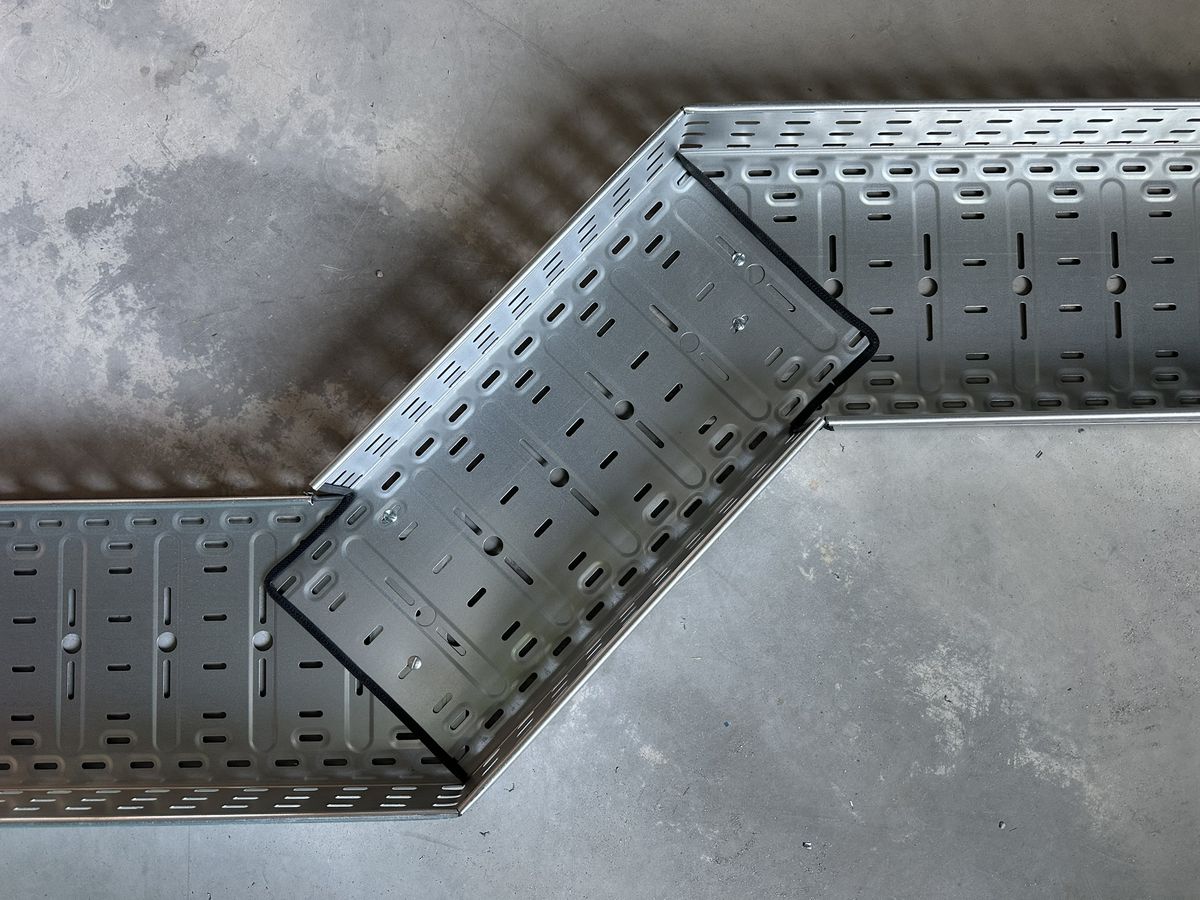
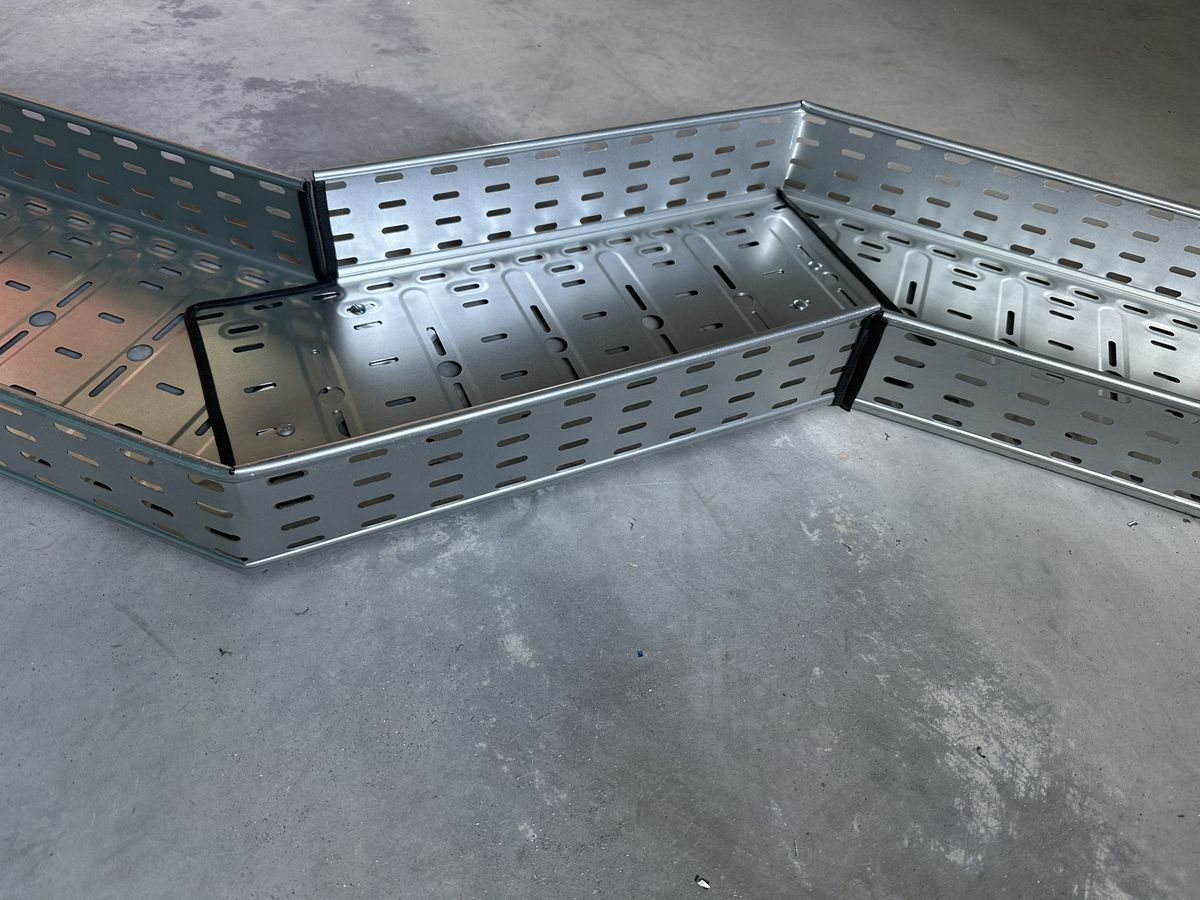
The offset was made to the figures from the calculator and fitted first time.
300 mm tray at 45°. Figures in mm. Each notch is 124 mm each way.
| Offset | Edge to centre | Centre to centre |
|---|---|---|
| 50 | 71 | 195 |
| 100 | 141 | 266 |
| 150 | 212 | 336 |
| 200 | 283 | 407 |
| 250 | 354 | 478 |
| 300 | 424 | 549 |
| 400 | 566 | 690 |
| 500 | 707 | 831 |